
OC Onboarding Is Live on iOS and Android
Fund subscription is still largely a paper process. OC Onboarding moves the whole of it onto the investor’s own phone — verification, funding details and signed documents — and lands every step in the same case file an administrator already works from. It is available now on the App Store and Google Play.


Fund subscription has long been the least digital part of an otherwise digital industry. An investor who can open a brokerage account in minutes may still be asked to print a subscription agreement, sign it by hand, scan it, attach a passport copy and a utility bill, and email the lot to an administrator, then wait without visibility while it is checked.
OC Onboarding replaces that with a guided journey on the investor’s own phone. The investor enters a fund or ISIN code, and the app assembles the right steps and document set for that fund and that investor type.
The Whole Journey, Not Just the Capture Step
Most mobile verification tools do one thing: photograph a document. OC Onboarding carries the complete subscription path, which is what actually determines whether an application completes.
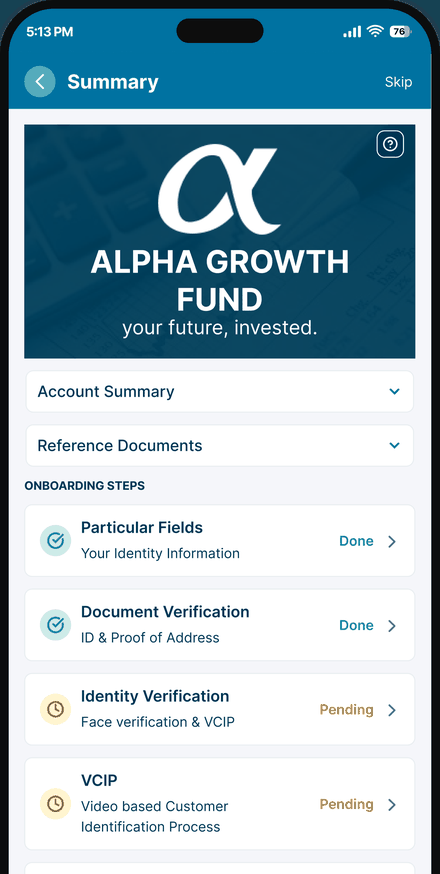
The investor sees the steps: which are done, and which are outstanding. That visibility does more work than it appears to. A large share of abandoned applications are not refusals but uncertainty, where the applicant has no idea whether anything is progressing and simply stops chasing.
- Particular fields — identity information, captured once.
- Document verification — ID and proof of address, captured on-device.
- Identity verification — face verification against the document.
- VCIP — video-based customer identification, where the jurisdiction or risk tier requires it.
VCIP on the Device the Investor Already Has
Video-based Customer Identification Process is a specific regulatory mechanism rather than a generic video call. The Reserve Bank of India’s V-CIP guidelines are its clearest codification; other regimes permit non-face-to-face onboarding on equivalent terms without using the same label. In each case the point is the same: a live, recorded, operator-led session that can be produced later as evidence.
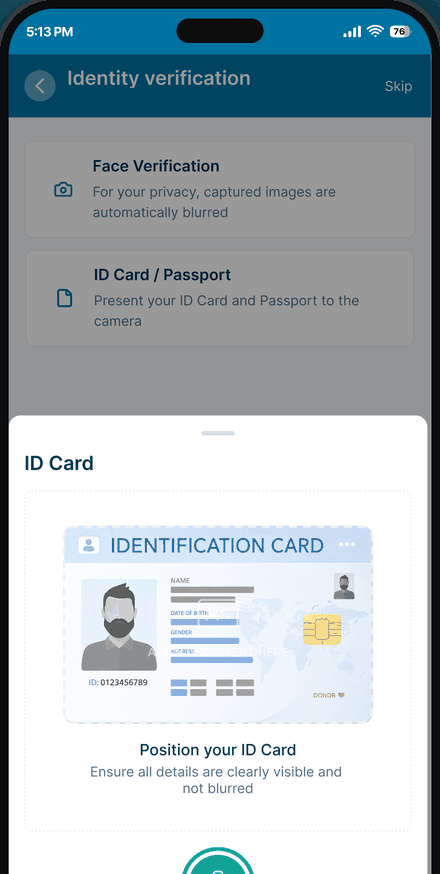
Running it in the app rather than a desktop browser matters practically. The camera is better, the lighting is easier to control, the connection is usually the investor’s own mobile data rather than contended office wifi, and the session can be resumed. Our Video KYC page covers the control side, and KYC verification the wider flow.
Signing Without Leaving the App
The document step is where paper-based subscription usually breaks down. OC Onboarding handles subscription agreements, additional subscription documents, switch order forms, redemption documents and account documents in-app, with digital signature support through DocuSign and a manual signature fallback.
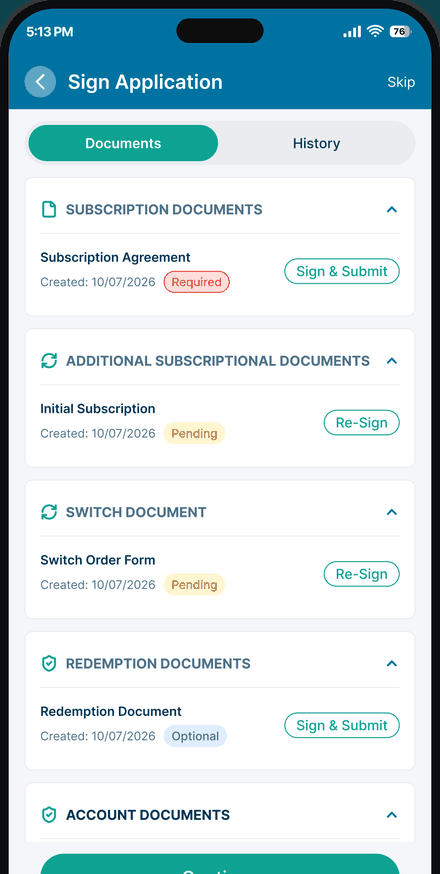
Each document carries its own status, so neither the investor nor the administrator has to reconstruct what is outstanding from an email thread. Where a document has to be signed again, that is an explicit state on the document itself rather than a fresh request buried in a reply.
Accounts, Banks and Wallets
The app supports individual, joint and corporate accounts, and holds them together rather than treating each application as an isolated form. Active, inactive and disabled holdings stay visible, which matters for an investor subscribing to more than one fund.
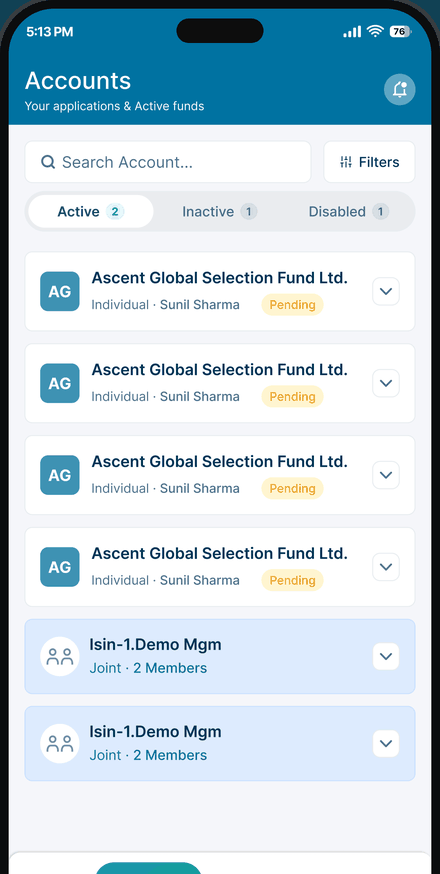
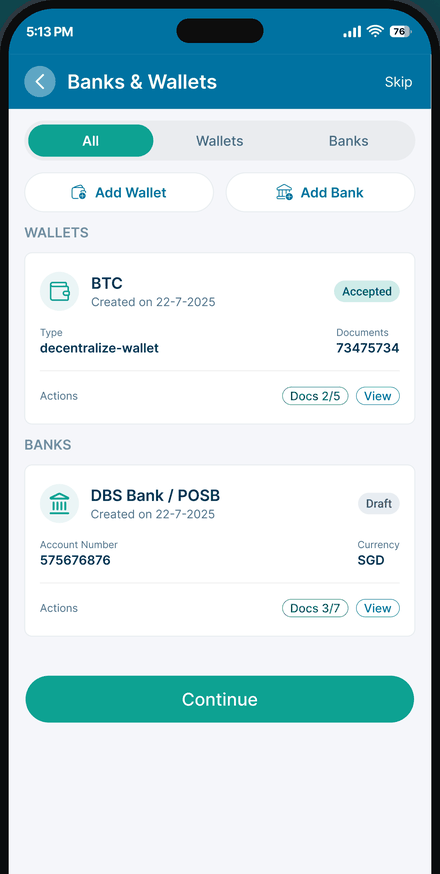
Funding details are captured with the same rigour as identity. Bank accounts and crypto wallets each carry their own document requirements and approval state, which keeps source-of-funds evidence attached to the instrument it relates to rather than filed loosely against the investor.
What This Changes for Administrators
The investor-side benefit is obvious. The administrator-side benefit is re-work.
In a manual subscription process a substantial share of analyst time goes on chasing: a passport photographed at an angle, a proof of address that has expired, a subscription agreement signed in the wrong place, a bank account with no supporting document. None of that work produces compliance value. It exists only because the error was caught late.
Capturing on-device with validation at the point of capture removes the loop rather than shortening it. Our cost benchmarking model isolates re-work as its own pool precisely because it is the most addressable part of the total, and usually the largest single saving available.
The Same Case, the Same Evidence
OC Onboarding is a capture channel, not a parallel system. Everything submitted through it lands in the same case record as a desktop or agent-assisted application, is screened against the same sanctions and PEP data, scored by the same risk model, and retained in the same audit trail.
That matters under inspection. A supervisor reviewing a subscription file should not be able to tell which channel it arrived through, because the evidence, the checks and the decision record are identical. Firms that bolt on a separate mobile stack tend to end up with two standards of file, and the weaker one sets their exposure. For administrators operating across several regimes, our paper on cross-border AML for fund administrators covers running one control spine rather than three.
Availability
OC Onboarding is published by Ascent Global Fintech Solutions Pte Ltd and is available now on both stores. The current release is version 53.0, published in September 2026.
The app is provisioned per client, so the steps, document sets, jurisdictions and branding follow the configuration already in place for that client’s onboarding flows. Once an investor is onboarded it also carries their holdings, statements and application status, so the same app serves the relationship rather than only the first day of it.
Existing clients can enable it from the Compliance Portal. To see the investor journey and the administrator view side by side, book a demo.
See the Investor Journey End to End
We will run a live subscription through the app — verification, VCIP, funding details and signing — then show the same case as your administration team sees it, with the screening and audit record attached.